Vishal Patel
 An MBA in Finance is a two-year postgraduate management programme that combines core business fundamentals with deep expertise in financial analysis, investment strategy, risk management, and corporate decision-making. Unlike a general MBA, the finance specialisation prepares graduates to take on leadership roles where financial perception is the primary competitive advantage, from investment banking and private equity to corporate treasury and fintech.
What is an MBA in Finance?
An MBA in Finance is a postgraduate management degree that combines the broad strategic foundations of an MBA with a focused specialisation in financial theory, analysis, and practice. While a general MBA covers marketing, operations, and human resources alongside finance, the finance track goes deeper, equipping students with the tools to manage capital, evaluate investments, assess risk, and drive data-informed financial decisions at a corporate or institutional level.

The programme is designed for aspiring professionals targeting leadership roles in banking, corporate finance, investment management, fintech, and financial consulting. It is equally relevant for working professionals seeking to transition into finance from adjacent fields, such as engineering, economics, or commerce, and for those already in finance who want to move into senior management.
Why Study an MBA in Finance in 2026?
The global finance landscape in 2026 looks fundamentally different from a decade ago. Artificial intelligence is reshaping financial modelling, ESG compliance is now a boardroom priority, and fintech has disrupted every traditional banking vertical. In this environment, an MBA in Finance is not just a credential; it is a strategic toolkit that enables professionals to lead with clarity when the rules of finance keep changing.
“Finance professionals with an MBA earn, on average, 40–60% more than peers without one within five years of graduation, and the gap widens significantly at the VP and C-suite levels, where an MBA is often a prerequisite rather than a differentiator.”
1. High ROI through salary growth and faster promotions
Finance roles in investment banking, private equity, and corporate treasury consistently rank among the highest-paid in the world. An MBA in Finance accelerates entry into these tracks and shortens the timeline to senior roles like CFO, Portfolio Manager, or VP of Finance by three to five years compared to non-MBA peers.
2. AI and data literacy are built into the 2026 curriculum
Modern MBA in Finance programmes now integrate AI-driven financial modelling, algorithmic trading fundamentals, and data analytics into the core curriculum, not as add-ons, but as foundational skills. Graduates can interpret machine-generated insights, build predictive financial models, and deploy fintech tools that were not part of finance education even three years ago.
3. Practical, live exposure, not just classroom theory
Top programmes have shifted toward live case studies, Bloomberg simulations, industry mentorships, and real-portfolio management projects. Students graduate having already navigated real-world market scenarios, making them immediately productive for employers rather than requiring an extended ramp-up.
4. Strategic leadership across finance and business operations
An MBA in Finance develops professionals who can bridge the gap between financial analysis and business strategy. Graduates develop a 360-degree understanding, enabling them to advise on mergers, capital allocation, market expansion, and risk management with genuine authority.
5. Global career mobility and cross-sector flexibility
Finance expertise is universally in demand, whether in New York, Dubai, Singapore, or Mumbai. An MBA in Finance from an accredited institution opens doors across banking, consulting, corporate finance, insurance, real estate, and government, giving graduates the freedom to pivot industries without starting over professionally.
6. Career switching made credible and structured
For engineers, doctors, or commerce graduates looking to move into finance, an MBA provides the structured transition pathway that self-study cannot replicate, combining academic rigour, peer networks, internship pipelines, and recruiter access that accelerates the shift into financial roles.
Basically the case for an MBA in Finance in 2026 comes down to one reality: finance is no longer just about numbers, it is about navigating complexity. Regulatory shifts, geopolitical risk, AI disruption, and ESG accountability have made financial leadership one of the most intellectually demanding disciplines in modern business. The MBA in Finance is the qualification designed precisely for that complexity.
How to do an MBA in Finance?
Pursuing an MBA in Finance in 2026 follows a structured admission process, from meeting basic eligibility requirements to clearing entrance exams, appearing for selection rounds, and finally enrolling at your chosen institution. Here is a clear, step-by-step breakdown of everything you need to know before you begin.
Step-by-step admission process
- Meet Academic Requirements: Hold a bachelor’s degree in any discipline from a recognised university, preferably in Finance, Economics, Commerce, or Accounting.
- Gain Work Experience: Most programmes prefer 2–3 years of professional experience, especially for Executive MBA tracks.
- Clear Entrance Exams: Appear for CAT, XAT, NMAT, or MAT for Indian programmes or GMAT/GRE for international admissions.
- Prove English Proficiency: International applicants must submit IELTS (6.0–6.5+) or PTE scores if English is not their first language.
- Choose Programme Format: Select from full-time, part-time, online, or executive MBA options based on your career stage and schedule.
- Pick Your Specialization: Focus on modules like Corporate Finance, Investment Management, Risk Management, and Financial Reporting to match your target career path.
An MBA in Finance is a well-defined journey, and with the right preparation at each step, from exam selection to specialization choice, you can secure admission to a programme that genuinely accelerates your finance career in 2026 and beyond.
BSc Finance vs MBA: Which degree is right for you?
Two of the most sought-after finance qualifications serve very different stages of a career. Here’s everything you need to compare them clearly before you decide.
| Factor | BSc Finance | MBA |
| Focus | Financial theory, markets, accounting, economics | Business strategy, leadership + finance specialization |
| Curriculum | Deep and technical,finance-specific subjects | Broad business education with finance electives |
| Career roles | Analyst, banker, accountant, investment associate | CFO, VP Finance, director, consultant, entrepreneur |
| Skills | Financial modelling, valuation, Excel, statistics | Strategy, leadership, negotiation, cross-functional mgmt |
| Next step | MBA, CFA, CA, CPA, M.Fin | Executive programmes, PhD, certifications |
MBA in Finance Scope in 2026?
The scope of MBA Finance is no longer limited to traditional banking and finance firms. In 2026, several fast-growing sectors are actively seeking finance professionals with both depth and versatility.

Fintech and digital banking
The fintech sector continues to be one of the fastest-growing employers of MBA Finance graduates. From payment infrastructure and lending platforms to wealthtech and insurtech, companies in this space need professionals who understand financial products deeply and can also navigate product strategy, fundraising, and regulatory compliance. Roles in fintech often come with competitive salaries, equity participation, and rapid career progression — making this sector particularly attractive for MBA graduates in 2026.
Sustainable finance and ESG investing
Environmental, social, and governance (ESG) investing has moved from a niche concept to a mainstream mandate for institutional investors globally. In 2026, banks, asset managers, and corporates are under increasing pressure to align their portfolios and operations with sustainability benchmarks. MBA Finance graduates who develop expertise in ESG analysis, green bonds, climate risk assessment, and sustainable capital allocation will find themselves in high demand across both Indian and global markets.
Private equity and venture capital
India’s startup ecosystem has matured significantly, with a large volume of growth-stage companies requiring structured funding, valuation support, and strategic financial guidance. Private equity and venture capital firms are actively hiring MBA Finance graduates who can conduct due diligence, structure deals, and manage portfolio companies. This sector offers some of the highest long-term earning potential in the finance domain and carries strong scope well into the next decade.
Global investment banking
Cross-border M&A activity, sovereign debt restructuring, and capital market transactions have rebounded strongly. Investment banks, both domestic and multinational, continue to recruit MBA Finance graduates for analyst and associate roles in 2026. The scope here is not limited to metros; with remote and hybrid working norms now embedded in financial services, graduates are securing positions in global banking operations from Indian cities that were not on the hiring map five years ago.
Corporate finance in large MNCs
Multinational corporations with significant Indian operations have expanded their finance functions substantially. Roles in FP&A (financial planning and analysis), treasury management, investor relations, and M&A advisory within large corporates like Tata, Reliance, Infosys, HDFC, and global MNCs offer stable, well-compensated, and career-defining opportunities for MBA Finance professionals in 2026.
MBA in Finance: Career & Salary Options
An MBA in Finance opens the door to some of the most rewarding and high-paying careers across banking, investment, consulting, and corporate finance. Graduates are equipped with financial planning, investment analysis, risk assessment, and strategic decision-making skills — making them valuable across industries in India and globally. Here are the most prominent career paths and their salary potential in 2026.
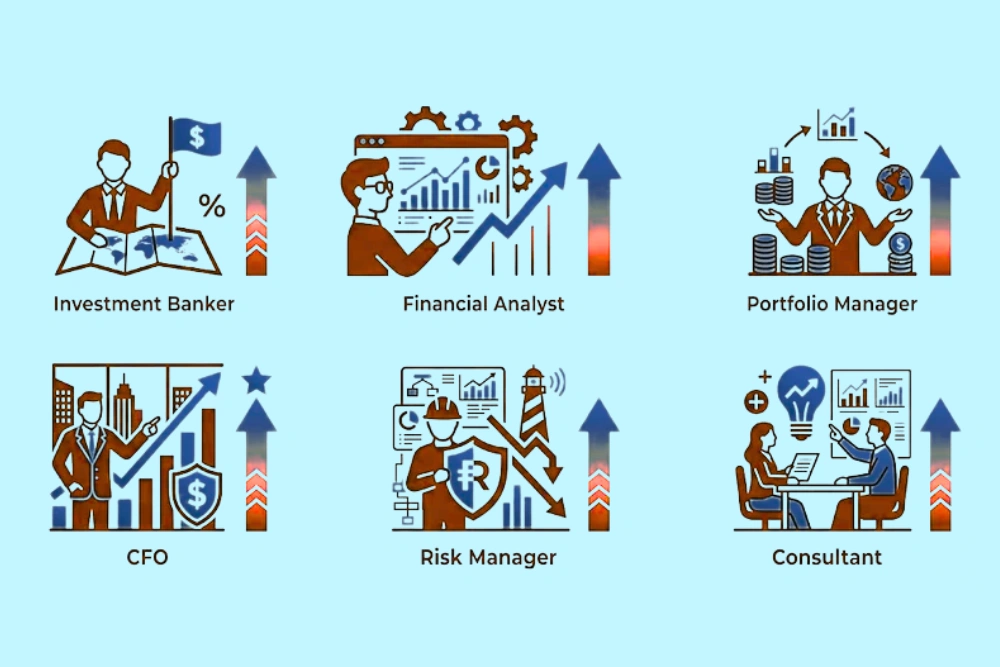
Investment Banker
Investment bankers help corporations, governments, and institutions raise capital and manage major financial transactions such as mergers, acquisitions, and IPOs. Known for its demanding workload and exceptionally high earning potential, this is one of the most sought-after career tracks for MBA Finance graduates.
Financial Analyst
Financial analysts evaluate investment opportunities, prepare financial forecasts, and support strategic business decisions. This role is widely considered the foundation for long-term growth in finance careers and is available across sectors — from banking and consulting to large corporates.
Portfolio Manager
Portfolio managers oversee investment portfolios for individuals, institutions, mutual funds, and wealth management firms. The role demands strong market knowledge, analytical depth, and the ability to balance risk with returns — making it one of the most intellectually rewarding tracks in finance.
| Career Role | Level | Salary (India) |
| Investment Banker | Associate | ₹15 – ₹50 LPA |
| Senior | ₹1 Cr+ | |
| Financial Analyst | Entry Level | ₹6 – ₹15 LPA |
| Mid-Career | ₹25 LPA+ | |
| Portfolio Manager | Standard | ₹20 – ₹60 LPA |
| Top Performers | ₹1 Cr+ |
Source of Reference for MBA in Finance Salary Options: Glassdoor India
Want to learn more about Finance, MBA & Career Growth?
Explore more expert guides, career insights, and industry trends, written to help you make smarter decisions about your education and career in 2026. Read more blogs from Techvantara.